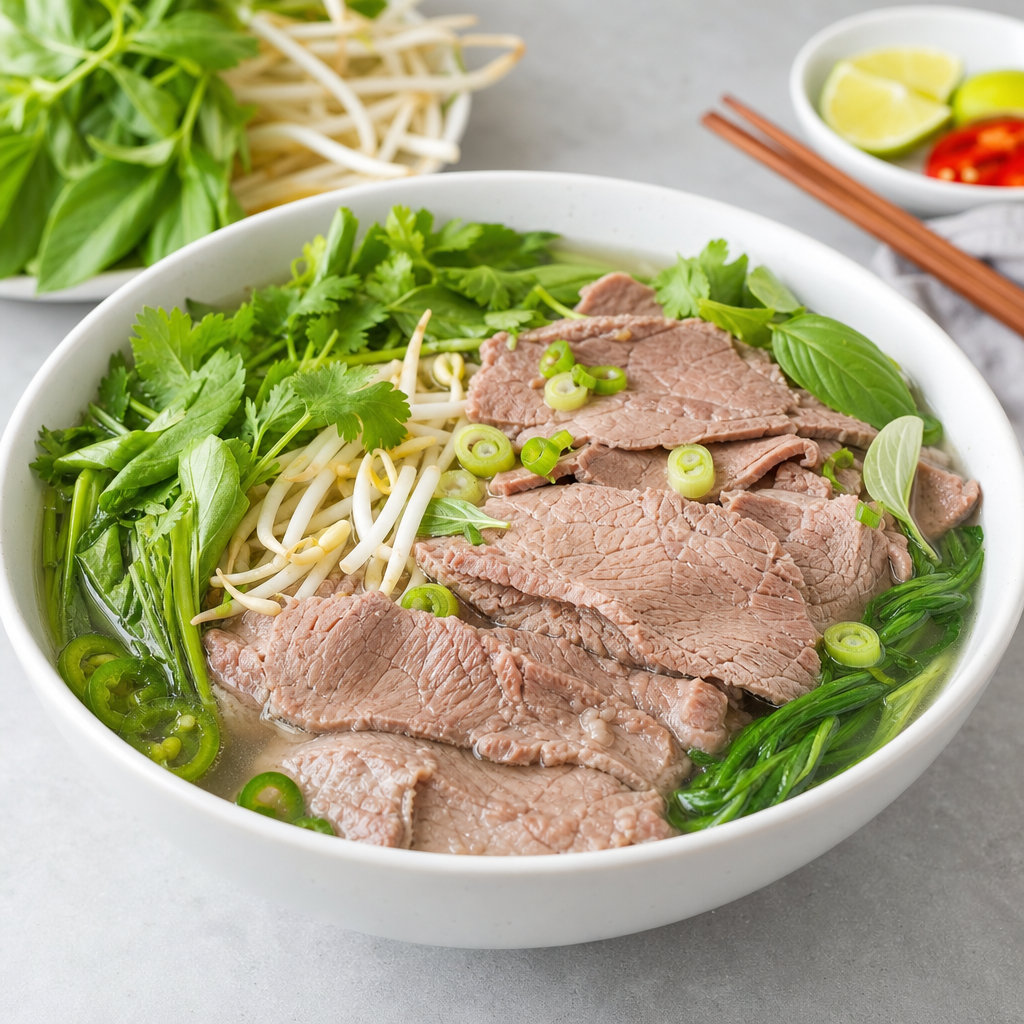
Is Pho Keto-Friendly?
The short answer: a traditional bowl of pho is not keto-friendly the way it usually arrives at the table, but pho is one of the easiest restaurant dishes to make keto with a single request. The keto diet generally limits carbohydrates to somewhere around 20-50 grams of net carbs per day. A standard bowl of pho, thanks to its generous portion of rice noodles, can hit or exceed that entire daily allowance in one sitting.
Here is the good news. If you mentally separate a bowl of pho into its parts — broth, meat, noodles, and garnishes — only one of them is a real carb problem. The rice noodles carry the overwhelming majority of the carbohydrates. The broth is nearly carb-free, the meat is essentially all protein and fat, and the fresh garnishes add only a gram or two. Remove or reduce the noodles and you are left with a warm, protein-rich, deeply savoury bowl that fits a low-carb lifestyle beautifully.
That structural advantage is why so many low-carb eaters gravitate toward pho. Unlike a sandwich built on bread or a rice plate built on rice, pho's flavour lives in the broth and the protein — the noodles are optional filler. If you are new to the dish itself, our ultimate guide to pho and Pho 101 explain how a bowl comes together before you start customising it.
How Many Carbs Are in a Bowl of Pho?
A full standard bowl of beef pho typically contains roughly 40-60 grams of net carbs, and the rice noodles account for almost all of it. Because portion sizes, noodle amounts, and recipes differ so much from kitchen to kitchen, treat every figure here as a general estimate rather than a lab-precise value — a large "extra noodle" bowl can go higher, and a modest bowl lower.
The most useful way to see it is to compare how the carb count changes with the noodle portion. Adjusting just the noodles is what turns pho from a high-carb meal into a keto-friendly one:
| How You Order It | Approx. Carbs | Keto Fit | Main Driver |
|---|---|---|---|
| Full bowl (standard noodles) | ~40-60 g net carbs | High-carb | Rice noodles are the main source |
| Half-noodle bowl | ~20-30 g net carbs | Moderate | Reduced noodle portion |
| No-noodle bowl | ~5-10 g net carbs | Low-carb | Broth sugar + garnishes only |
Breaking a bowl down component by component makes the picture even clearer. Notice how everything except the noodles and the hoisin sauce is already low in carbs:
| Component | Approx. Carbs | Status | Notes |
|---|---|---|---|
| Rice noodles (banh pho, ~1 cup) | ~35-45 g | High-carb | The single biggest carb source — the reason pho isn't keto by default |
| Pho broth (per bowl) | ~2-5 g | Low-carb | Mostly water and bone broth; small rock-sugar addition |
| Sliced beef / poached chicken | ~0 g | Low-carb | Protein and fat only — keto-friendly |
| Beef meatballs (bo vien) | ~2-4 g | Moderate | May contain a little starch binder |
| Bean sprouts, herbs, lime, chili | ~1-3 g | Low-carb | Fibrous garnishes — very low carb |
| Hoisin sauce (1 tbsp) | ~5-7 g | High-carb | High in added sugar — skip it on keto |
| Sriracha (1 tbsp) | ~1-2 g | Moderate | Contains some added sugar; use sparingly |
These estimates are for general guidance and will vary by restaurant and portion. If you track macros closely, the safest approach is to base your count on the noodle portion you actually eat rather than the bowl's total — and to remember that table sauces like hoisin can quietly add carbs you did not plan for. For a wider look at how pho fits into a balanced diet, see our guide to whether pho is healthy.
Is Pho Broth Keto?
Yes — pho broth is one of the most keto-friendly parts of the entire dish. A traditional pho broth is essentially a bone broth: water simmered with beef or chicken bones for 12 hours or more, along with charred onion and ginger and a spice sachet of star anise, cinnamon, cloves, coriander seed, and cardamom. What you get is a liquid rich in collagen, minerals, and rendered fat, but very low in carbohydrates.
The one honest caveat is sugar. Most authentic pho recipes add a small amount of rock sugar to round out and balance the savoury, spiced broth. This is a modest quantity spread across a large pot, so per bowl it contributes only a few grams of carbohydrate — far less than the noodles or a spoon of hoisin. If you are counting every gram, you can ask whether the broth is sweetened, but for most low-carb eaters the broth is not the part to worry about.
Because the broth is where pho's character lives, it also means a no-noodle bowl still tastes like pho — you are not sacrificing the soul of the dish to cut carbs. If you want to understand exactly what goes into that broth, our breakdown of what pho soup is made of and our home pho recipe walk through the full process, sugar and all.
How Do You Order Keto Pho at a Restaurant?
Ordering keto pho is genuinely easy, and most Vietnamese restaurants are used to the request. The core idea is simple: remove the carb-heavy noodles, replace the lost bulk with protein and vegetables, and avoid the sugary table sauces. Here is how to do it in practice:
Ask for no noodles
The simplest swap. A no-noodle bowl of broth, meat, and herbs drops to roughly 5-10 g net carbs.
Add extra bean sprouts
Sprouts add crunch and volume in place of noodles for almost no carbs — request a double portion.
Order extra meat
More rare beef, brisket, or chicken keeps a noodle-free bowl filling and protein-rich.
Skip the hoisin
Hoisin is the biggest hidden sugar at the table. Flavour with lime, chili, and fish sauce instead.
Go easy on sriracha
Sriracha has some added sugar too. Fresh sliced chili delivers heat with none of it.
Choose broth-forward bowls
Let the 12+ hour broth and quality protein carry the meal rather than the carbs.
A quick script that works almost anywhere: "Can I get the beef pho with no noodles, extra bean sprouts, and extra rare beef, please?" That single sentence transforms a 40-60 gram bowl into one hovering around 5-10 grams of net carbs. If you want a little of the noodle texture, ask for a half portion instead of none.
One more tip: the flavour boosters that come free at the table — lime, fresh chili, Thai basil, cilantro, and a splash of fish sauce — are all low in carbs and let you season without reaching for hoisin. If you want to know exactly which garnishes do what, our pho toppings and garnishes guide and our guide on how to eat pho cover the whole ritual.
Are the Meat and Garnishes in Pho Keto?
The proteins in pho are almost perfectly keto. Thinly sliced rare beef (tai), well-done brisket (chin), flank (nam), tendon (gan), and poached chicken are essentially carb-free — they bring protein and fat, exactly what a keto plate is built around. That is why "extra meat, no noodles" is such an effective order: you keep the bowl satisfying without adding carbohydrates. The one small exception is beef meatballs (bo vien), which sometimes include a little starch as a binder, so they carry a couple of grams each. If you want to learn the cuts, our pho dac biet guide explains the full "special combo" bowl.
A quick word on food safety, since keto eaters often ask about the rare beef. The thin slices of raw beef are placed in the bowl and the near-boiling broth is ladled over top, cooking them almost instantly. For the general population this is a normal, safe way to enjoy pho. If you are pregnant, immunocompromised, or otherwise advised to avoid rare meat, simply ask for your beef well-done (chin) — it is just as keto-friendly and every bit as flavourful.
The garnishes are equally friendly. Bean sprouts, Thai basil, cilantro, sliced chili, and a squeeze of lime are fibrous and very low in carbs, which is why bean sprouts make such a good stand-in for the missing noodles — they add crunch and volume for almost nothing on the carb ledger.
Which Vietnamese Dishes Are Low-Carb vs High-Carb?
Pho is far from the only Vietnamese dish that can work on a low-carb plan — and knowing which items are naturally lighter makes ordering easier. As a rule of thumb, broth-forward and grilled-protein dishes adapt best, while anything built on rice, vermicelli, or a baguette is carb-dense. Here is how the most common dishes compare:
| Dish | Carb Level | Status | Notes |
|---|---|---|---|
| Pho, no noodles (extra meat & sprouts) | Very low | Low-carb | The most keto-friendly way to eat pho |
| Grilled meats or seafood (no rice) | Very low | Low-carb | Lemongrass beef, chicken, or shrimp on greens |
| Fresh spring rolls (goi cuon) | Moderate | Moderate | Rice-paper wrappers add carbs; enjoy in moderation |
| Vermicelli bowls (bun) | High | High-carb | Rice vermicelli is carb-dense like noodles |
| Rice plates (com) | High | High-carb | Broken or jasmine rice is a large carb load |
| Banh mi sandwich | High | High-carb | The baguette is wheat-based and high-carb |
| Vietnamese iced coffee (ca phe sua da) | High | High-carb | Sweetened condensed milk adds significant sugar |
The pattern is consistent: it is almost always the starch — the noodles, the rice, the baguette — that pushes a dish out of keto range, not the protein or the aromatics. Fresh spring rolls (goi cuon) sit in the middle because their rice-paper wrappers add some carbs; enjoy one or two rather than a full plate. Fried spring rolls and the wheat-based banh mi baguette are the higher-carb end of the spectrum.
If you want to explore the cuisine more broadly, our Vietnamese food guide covers every essential dish, and our banh mi guide explains why that beloved sandwich is a treat to enjoy occasionally rather than a keto staple. You can also browse our full menu to plan a low-carb order in advance.
Is Pho Good for a Low-Carb Diet in General?
For a general low-carb approach — not just strict keto — adapted pho is a genuinely strong choice. A no-noodle or half-noodle bowl delivers quality protein from the meat, satiety and warmth from the broth, and fibre and freshness from the herbs and sprouts, all without a heavy carbohydrate load. It is hydrating, it is filling, and it is easy to customise to hit whatever daily carb target you are working toward.
It is worth keeping two things in perspective. First, low-carb and keto are not the same: a low-carb diet may comfortably accommodate a half-noodle bowl, while strict keto usually calls for skipping the noodles entirely. Match the bowl to your own plan. Second, pho — like most restaurant soups — is high in sodium. That is a normal feature of a salted broth, not a keto issue specifically, but anyone watching blood pressure or fluid balance should factor it in. Sipping less of the broth or asking for a lighter-salt bowl are simple ways to manage it.
Compared with many other noodle soups, pho also tends to be lighter and lower in carbs from added sauces and toppings — our pho vs ramen comparison and our look at whether pho is healthier than ramen dig into those differences if you are choosing between soups.
Who Should Talk to a Doctor or Dietitian First?
Everything above is general nutrition information, not medical advice. Keto and very-low-carb diets are not right for everyone, and the best carb, sodium, and protein targets depend on your individual health. It is a good idea to speak with your doctor or a registered dietitian before starting keto or making significant changes to how you eat — especially if any of the following applies to you:
- You have diabetes or manage blood sugar with medication. Cutting carbs can affect medication needs and should be supervised.
- You have kidney concerns or high blood pressure. Broth-based soups are high in sodium, which may need to be limited.
- You are pregnant or breastfeeding. Both carb targets and rare-meat choices deserve professional input — ask for well-done beef.
- You have a history of disordered eating. Rigid carb counting is not appropriate for everyone.
- You take medications affected by diet changes. A quick check with your provider avoids surprises.
A registered dietitian can help you build a sustainable plan that still leaves room for foods you love — including a well-ordered bowl of pho. The aim is not to fear any single dish, but to fit it sensibly into an eating pattern that works for your body and your goals.
Frequently Asked Questions About Keto Pho
Is pho keto-friendly?
Traditional pho is not keto-friendly as served because a standard bowl contains roughly 40-60 grams of carbohydrates from rice noodles — more than a full day's allowance on a strict keto diet. However, the broth and meat are very low in carbs, so pho is easy to adapt: order it with no noodles (or half noodles) and extra bean sprouts, and skip the hoisin, and a bowl can fit comfortably into a low-carb or keto approach.
How many carbs are in a bowl of pho?
A full standard bowl of beef pho typically has about 40-60 grams of net carbs, the vast majority coming from the rice noodles. The broth itself adds only a few grams and the sliced meat adds essentially none. These are general estimates — actual numbers vary widely with bowl size, noodle portion, added sauces, and each restaurant's recipe.
Can I eat pho without the noodles on keto?
Yes. Ordering pho without noodles is the simplest way to make it keto-friendly. A no-noodle bowl of broth, meat, herbs, and bean sprouts drops to roughly 5-10 grams of net carbs, most of it from garnishes and the small amount of sugar in the broth. Ask for extra meat or extra bean sprouts to keep the bowl filling.
Is pho broth keto?
Pho broth is nearly keto on its own. A long-simmered bone broth is mostly water, collagen, minerals, and rendered fat, with very few carbohydrates. The main carb source is a small amount of rock sugar used to balance the flavour, which adds only a few grams across an entire bowl. Broth is one of the most keto-friendly parts of pho.
Does pho broth have sugar?
Most traditional pho broth includes a small amount of rock sugar to round out the savoury, spiced flavour. The quantity per bowl is modest, but it does add a few grams of carbohydrate. If you are counting carbs closely, you can ask whether the broth is sweetened, though the noodles and hoisin sauce contribute far more sugar than the broth does.
How do I order low-carb pho at a restaurant?
Ask for no noodles or half noodles, request extra bean sprouts or extra meat to replace the bulk, and skip the hoisin and sriracha at the table (hoisin is high in sugar). Season with lime, chili, fresh herbs, and a little fish sauce instead. Most Vietnamese restaurants are happy to customise a bowl this way.
Is hoisin sauce keto-friendly?
No. Hoisin sauce is one of the least keto-friendly parts of a pho meal because it is high in sugar — often around 5-7 grams of sugar per tablespoon. Sriracha also contains added sugar, though usually less. On a low-carb diet, flavour your bowl with lime, fresh chili, herbs, and fish sauce instead.
Are rice noodles keto?
No. Banh pho rice noodles are made from rice flour and are high in carbohydrates — the single biggest reason traditional pho is not keto. They are, however, naturally gluten-free, which is a different consideration. If you want the noodle experience while staying low-carb, some diners bring shirataki (konjac) noodles or simply enjoy extra bean sprouts for texture.
Is the meat in pho keto-friendly?
Yes. The proteins in pho — thinly sliced rare beef, brisket, flank, meatballs, or poached chicken — are essentially carb-free and fit well into a keto diet. Meatballs (bo vien) can contain a small amount of starch as a binder, so they are a minor exception. Ordering extra meat is a good way to make a no-noodle bowl more satisfying.
What is the most keto-friendly Vietnamese dish?
A no-noodle bowl of pho, grilled meats or seafood without rice, and fresh (not fried) spring rolls eaten in moderation are among the most low-carb Vietnamese options. Broth-forward dishes and grilled-protein plates adapt best. Rice, vermicelli, banh mi baguettes, and sweet drinks like Vietnamese iced coffee with condensed milk are the high-carb items to limit.
Is pho good for a low-carb diet in general?
Adapted pho can be an excellent fit for a general low-carb diet because it is protein-rich, hydrating, and easy to customise. A no-noodle or half-noodle bowl gives you warm broth, quality protein, and vegetables without the heavy carb load. As always, individual carb targets vary, so anyone managing a medical condition should personalise their approach.
Should I ask a dietitian before making pho part of a keto diet?
If you have diabetes, kidney concerns, are pregnant, or manage any medical condition, it is wise to speak with your doctor or a registered dietitian before starting keto or making significant diet changes. This article offers general information, not medical advice. A professional can help you set safe carb, sodium, and protein targets for your situation.
Low-Carb Pho, Your Way, in Ottawa's ByWard Market
At Pho By Night, every broth is slow-simmered for 12+ hours and every bowl can be customised — no noodles, extra bean sprouts, extra meat, hold the hoisin. Just ask, and we will build a bowl that fits your diet.
Share This Guide
Related Articles
Is Pho Healthy?
Complete nutrition guide — calories, bone broth benefits, and more
Is Pho Fattening?
The honest take on calories, carbs, and weight management
Is Pho Healthier Than Ramen?
How the two beloved noodle soups compare nutritionally
What Is Pho Soup Made Of?
Every ingredient in an authentic 12-hour broth
Pho Toppings & Garnishes Guide
Every herb, sprout, and sauce — and how to use them
The Ultimate Guide to Pho
History, regional styles, and everything in one place